
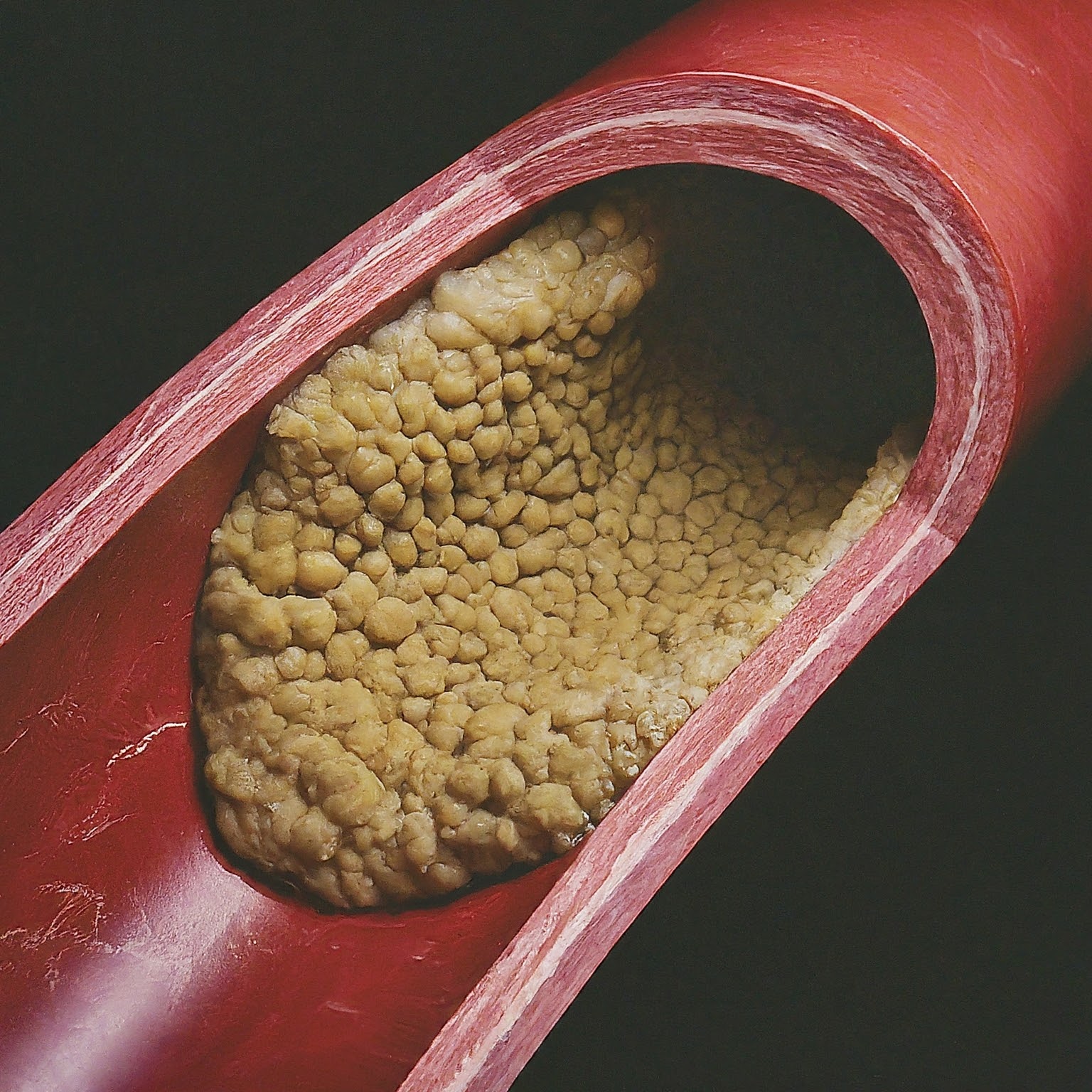
Imagine your arteriesBlood vessels are like tiny pipes or tubes that create a transportation network throughout your body. They carry blood, which delivers essential nutrients and oxygen to your cells and removes waste products. Think of them as the highways and roads that supply your body’s cells with fuel! • Other Names:… Read More as a network of pipes that carry bloodBlood is the life force coursing through your veins and arteries, delivering vital oxygen and nutrients to every cell in your body while whisking away waste products. It’s a complex, dynamic fluid—not just a simple red liquid. Consider it a bustling highway system within your body, carrying various cellular vehicles… Read More throughout your body. Atherosclerosis1. Simple Definition: Imagine that your arteries, the blood vessels that carry oxygen and nutrients throughout your body, are like pipes. Over time, a sticky substance called plaque can build up on the inside walls of these pipes. Atherosclerosis is the name for this buildup of plaque. As the plaque… Read More is like rust forming inside these pipes, narrowing them and restricting blood flow. Now, think of sugar not just as a sweet treat but as a potential corrosive agent that can accelerate this rusting process. The question “Does Sugar Play A Role In Atherosclerosis?” explores whether and how this sweet substance might contribute to the development of this dangerous condition.
Detailed EtymologyEtymology is the study of the origin and history of words. It’s like detective work, tracing how words have changed over time and moved between languages. Think of it like this: • Words have a long history, just like old family stories. • Etymology digs into those stories to see… Read More
The question is a combination of several key terms:
- Sugar: A broad term for sweet, soluble carbohydratesCarbohydrates, often called carbs for short, are organic molecules that your body uses for energy. They’re one type of fuel the body can use for energy. Carbohydrates are made up of carbon, hydrogen, and oxygen atoms, hence the name “carbohydrate” (carbo = carbon, hydrate = water). They come in simple… Read More, including glucoseGlucose, a simple sugar (a sweet substance the body uses for energy), serves as a vital component in the human body, acting as the primary fuel for cells (tiny units that make up the body). Imagine the body as a bustling factory, where glucose is like the electricity powering the… Read More, fructoseFructose is a type of sugar found naturally in fruits and some vegetables. It’s also added to processed foods and drinks, contributing to its high consumption. Think of it like this: • Fructose is the sweetest of the naturally occurring sugars. • Your body processes fructose differently than other sugars,… Read More, and sucroseSucrose is a type of sugar found abundantly in nature. It’s the white, crystalline substance we commonly know as table sugar. Imagine those tiny granules you sprinkle on your cereal or stir into your coffee – that’s sucrose. It’s a simple carbohydrate that our bodies break down to use as… Read More.
- Play A Role: To have an effect or influence on something.
- Atherosclerosis: From the Greek words “athere” (gruel or porridge) and “sclerosis” (hardening), referring to the buildup of fatty deposits in the arteries.
While the individual words have ancient roots, the question itself is a product of modern scientific inquiry, emerging as researchers began to investigate the link between diet and heart health.
Real-World Applications
- Doctor’s Office: “Given your family history of heart disease and your high sugar intake, we need to discuss the potential role of sugar in atherosclerosis and ways to reduce your risk.”
- Research Lab: “Our latest study explores the molecular mechanisms by which sugar may accelerate atherosclerosis, potentially opening up new avenues for treatment.”
- Public Health Campaign: “Cut back on sugary drinks and processed foods to protect your heart and reduce your risk of atherosclerosis.”
Contextual Information
Atherosclerosis is a complex process involving various factors, including genetics, lifestyle, and diet. It begins with damage to the inner lining of arteries, often caused by high blood pressure or cholesterolCholesterol is a waxy, fat-like substance found in your body and in the foods you eat. It’s an essential building block for healthy cells, but too much of a bad kind can be a problem. Imagine cholesterol as building blocks; they’re necessary for cell structure, but using the wrong type… Read More. This damage triggers inflammationInflammation is your body’s natural response to injury or infection. Imagine it like a fire alarm going off in your body, sending out signals to fight off invaders and heal damaged tissues. • Other Names: You might not hear many other names for inflammation in everyday conversation. Scientists sometimes use terms… Read More, leading to the accumulation of fatsThe substance known as fat occupies a role far more complex and vital than often perceived. While frequently discussed in terms of diet and appearance, this tissue, properly termed adipose tissue when referring to the cellular mass, is a dynamic and essential component supporting a myriad of the body’s critical… Read More, cholesterol, and other substances, forming plaques that narrow the arteries.
Sugar, particularly in excess, can contribute to this process in several ways:
- Increased triglycerides: Sugar raises levels of triglycerides, a type of fat in the blood, which is a risk factor for atherosclerosis.
- Insulin resistanceInsulin resistance is a condition where your body’s cells become less responsive to the hormone insulin. Imagine you have a key (insulin) that unlocks the door (cells) to let sugar (energy) in, but the key isn’t working as well as it should. Here’s a breakdown to make it clear: •… Read More: High sugar diets can lead to insulinYour pancreas produces the super hormone insulin, which is essential to your body’s metabolism. Here’s a breakdown to make it clear: Definition: Insulin acts like a master key that unlocks the door for sugar (glucose) to enter your cells. Glucose is the main source of energy for your body, and… Read More resistance, a condition where the body’s cellsThe cell is the basic building block of the human body, a tiny, microscopic (too small to see without a magnifying tool like a microscope) unit that works together with billions of other cells to form every part of the body, from the skin to the heart. Each cell is… Read More become less responsive to insulin. This can further elevate triglycerides and promote inflammation.
- Oxidative stressOxidative stress is a state of imbalance within the body, where the production of harmful molecules called free radicals outpaces the body’s ability to neutralize them. It’s akin to a seesaw tipping precariously, where the reactive oxygen species (free radicals) outweigh the antioxidants meant to keep them in check. While… Read More: Sugar can trigger oxidative stress, a process that damages cells and contributes to plaque formation.
Lab Reports and Medical Records
While the question itself won’t appear in medical records, lab tests can reveal markersThe word “marker” has a rich history and multiple meanings, but in the context of the human body or living organisms, it typically refers to an indicator or signal that provides information about something else. Here’s a breakdown: Etymology and Origin: • Marker: This word likely emerged around the 14th… Read More of atherosclerosis, such as high cholesterol and triglyceride levels. Doctors might also note a patient’s dietary habits, including sugar intake, as part of a comprehensive risk assessment.
Health Implications
Atherosclerosis is a leading cause of heart disease, stroke, and peripheral artery disease. Understanding the role of sugar in this condition is crucial for prevention and treatment.
Research Insights
Numerous studies have investigated the link between sugar and atherosclerosis.
- A 2016 study in the Journal of the American Medical Association Internal MedicineMedicine is the field of science and practice that deals with the prevention, diagnosis, treatment, and cure of disease. Think of it like this: • Your body is a complex machine. • Medicine is like a toolbox, and knowledge is needed to keep it running smoothly. • Doctors, nurses, and… Read More found that people with the highest sugar intake had a significantly increased risk of dying from cardiovascular disease.
- Research from the University of Surrey suggests that sugar may disrupt the way the liverThe liver is a large organ located in the upper right part of the belly, under the rib cage. Like the heart that pumps blood or the lungs that help with breathing, the liver plays a crucial role in keeping the body healthy and working properly. This important organ is… Read More metabolizes fat, potentially contributing to atherosclerosis.
- A study at Weill Cornell Medicine discovered that excess blood sugarBlood sugar, also known as blood glucose, is a type of simple sugar circulating in your bloodstream. It can be a primary source of energy for your cells. Your body can get blood sugar from carbohydrates that you eat. The Word “Blood Sugar” This term is a modern invention, emerging… Read More can react with immune proteinsImagine your body as a bustling construction site, where every structure is meticulously built and maintained. Proteins are the versatile workers that make it all happen. They’re not just one thing but an entire workforce, each with a specialized role. Some proteins build and repair tissues; others act as enzymes… Read More, leading to inflammation that promotes atherosclerosis.
These findings underscore the need to limit added sugar intake for optimal cardiovascular health.
Additional Facets
- KetosisA Deep Dive into the Metabolic State Transforming Health and Wellness Imagine your body as a hybrid car, capable of running on two distinct fuel sources: gasoline (carbohydrates) and electricity (fat). Ketosis is like switching your body’s engine from gasoline to electricity, primarily using fat for fuel instead of carbohydrates…. Read More: While ketosis, a state where the body burns fat for fuel instead of carbohydrates, might help improve some risk factors for atherosclerosis, it’s not a substitute for a balanced diet low in added sugarsSugar is a substance represented as a simple carbohydrate (a basic type of molecule made of carbon, hydrogen, and oxygen) that serves as a vital component throughout the body. It is the primary source of energy for most cells, acting like the body’s main fuel. Every part of the body,… Read More.
- Sugar and Inflammation: The link between sugar and inflammation is complex. Some research suggests that certain types of sugar, like fructose, may be more inflammatory than others.
- Controversies: The food industry has often downplayed the role of sugar in chronicChronic simply means “happening over a long period of time” or “of long duration.” Imagine a situation that keeps going on and on, unlike something short-lived. • Other Names: You might not encounter many other terms for chronic in everyday conversation. In some specific contexts, terms like “long-term” or “persistent”… Read More diseases, sometimes funding research that challenges existing evidence.
Conclusion
The answer to the question “Does Sugar Play A Role In Atherosclerosis?” is increasingly clear: Yes, excessive sugar consumption can contribute to the development and progression of this dangerous condition. By understanding this link, individuals can make informed choices about their diet, prioritize heart-healthy habits, and work with healthcare professionals to reduce their risk.